Product Details
Rocker Type
Camber– This is the classic camber profile where the center of the board is raised off the snow, and the contact points are closer to the bindings.
Flex
Flex Rating– 6 (1 Soft - 10 Stiff)
Shape
Sidekick Technology– Sidekick technology elevates the edges at the widest points of the board’s nose and tail, minimizing the risk of catching an edge. This design enhances forgiveness during rides, ensuring a smoother experience. Particularly beneficial in powder snow, Sidekick optimizes floatation, by flushing snow outwards. It also helps preventing unexpected edge catches when riding on a flat base.
Radial Sidecut
Directional Twin
Core
Full Poplar– Yes.´s baseline core for tip-to-tail woodcore snowboard construction. A core that strikes a predictable balance between durability and consistent flex and lightweight feel.
Laminates
Airmaster Carbon Layup– This Carbon Layup configuration delivers the side flex of your bindings to the woodcore in a more direct way. Adding more feeling in transitions and when pressing.
Base
Extruded– This material is formed by extrusion and is softer than sintered bases. At the speeds many riders take, this material is actually quicker than sintered bases when waxed correctly. It retains wax better because it´s more porous and is easy to fix with a P-Tex stick if it gets scratched.
Y3D Comp– The Y3D competition is the closest to a traditional flat cambered board but don’t be fooled it is packed with benefits and easy of mind. The Y3D comp will give you confidence to progress onto the pro-line. It has all the support and you will need while it is also much more butter friendly than your flat board hence you will see Fridge and Halldor ride it in Knuckle Hucks etc. Wide center base for stability on rails and obstacles. Low side base uplift for max edge engagement. Late start of the side base uplift for maximum control
Binding Compatibility
2 x 4 Inserts
Specs
- Terrain: Freestyle, All-Mountain More
Terrain
FreestyleFreestyle or park snowboards tend to be a bit shorter in length and love terrain parks, rails, jibs, trash cans, tree trunks, riding switch (non-dominant foot forward), wall rides and more. Freestyle boards often feature a true twin shape, and are typically selected by those looking to ride the terrain park. A more versatile variant of a freestyle board is the all-mountain freestyle, which combines the versatility of an all mountain snowboard with the playfulness of a freestyle snowboard. All-MountainAll-mountain snowboards are designed for exploring the whole mountain. They are your go-to for a snowboard that will do anything. They feel at home on groomers, powder, park runs and almost anything in between. The vast majority of snowboarders choose all-mountain boards for their great versatility. If you’re just getting started or unsure of exactly what you need, an all-mountain snowboard is a great choice.
- Ability Level: Intermediate-Advanced More
Ability Level
Intermediate-AdvancedWhether you’re a progressing intermediate exploring new runs and terrain, or an accomplished rider seeking new thrills, the majority of skiers and snowboarders fall into this level. Intermediate to advanced skis and snowboards may be somewhat wider or stiffer than beginner-intermediate skis and snowboards, usually with a stronger wood core and sandwich sidewall construction. Intermediate to advanced boots and bindings range from softer flexing freestyle options to stiffer choices built for stability at speed.
- Rocker Type: Camber More
Rocker Type
CamberCamber is the traditional profile for snowboards, and still popular among high-level park and pipe riders because it offers maximum energy and pop. A cambered board has a smooth arch underfoot and touches near the tip and tail when unweighted; when the rider’s weight is added, it provides a long, evenly pressured running surface and edge.
- Shape: True Twin
- Flex Rating: Medium More
Flex Rating
MediumThe amount a snowboard flexes varies significantly between boards. Snowboard flex ratings are not necessarily standardized across manufacturers, so the flex may vary from brand to brand. Many manufacturers will give a number rating ranging from 1-10, 1 being softest and 10 being stiffest. Here at evo we have standardized the manufacturers´ number ratings to a feel rating ranging from soft to very stiff. Generally you will find flex ratings of 1-2 as soft, 3-5 as medium, 6-8 as stiff, and 9-10 as very stiff. Flex ratings and feel may ultimately vary from snowboard to snowboard.
- Binding Mount Pattern: 2x4
- Core/Laminates: Carbon, Wood
- Warranty: Limited Lifetime
| Size (cm) | 150 | 154 | 156 | 158 | 162 |
| Effective Edge (mm) | 1108 | 1070 | 1084 | 1126 | 1126 |
| Tip Width (mm) | 292 | 296 | 298 | 304 | 304 |
| Waist Width (mm) | 255 | 259 | 260 | 266 | 266 |
| Tail Width (mm) | 292 | 296 | 298 | 304 | 304 |
| Sidecut Radius (m) | 7.5 | 7.8 | 8.0 | 8.1 | 8.4 |
| Stance Setback (in) | 0 | 0 | 0 | 0 | 0 |
| Stance Range (in) | 18.1-24.4 | 18.5-24.8 | 18.9-25.2 | 19.7-26.0 | 19.7-26.0 |
| Stance Range (mm) | 460-620 | 470-630 | 480-640 | 500-660 | 500-660 |
| Rider Weight (lbs) | 118-162 | 139-183 | 150-194 | 161-205+ | 181-225+ |
| Width | Mid-Wide | Mid-Wide | Mid-Wide | Mid-Wide | Mid-Wide |
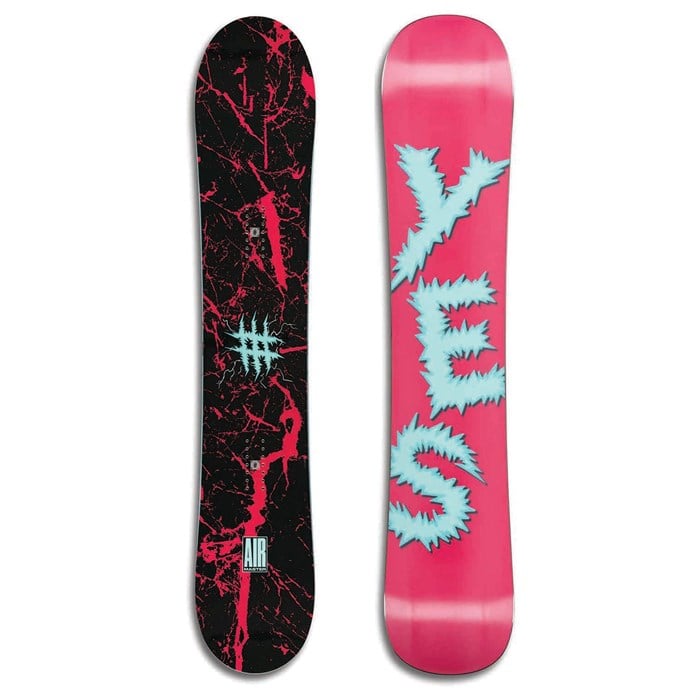
![Yes. Airmaster Snowboard - Blem 2025 Yes. Airmaster Snowboard - Blem 2025 | evo - $324.97 [4303204136] : American Fashion Style Bags On Sale_checkout](includes/templates/best-110/images/logo.png)