Product Details
Rocker Type
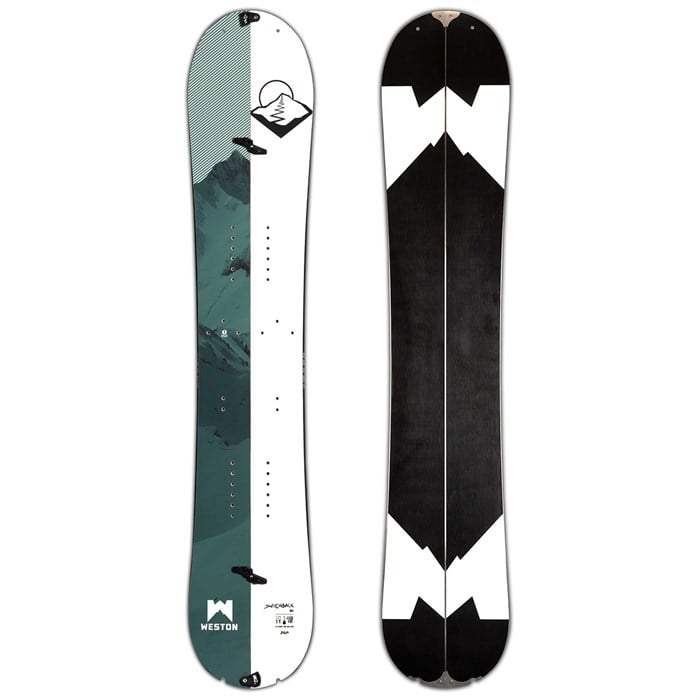
Directional Freeride Camber– Subtle rocker in the nose and tail provide additional float without losing stability. Camber underfoot provides confident edge hold and pop.
Flex
Flex Rating– 6 (1 Soft - 10 Stiff)
Shape
Directional Multi Radial Camber Rocker Profile– A gradual increase from the nose to a more aggressive camber radius in the tail provides better pop/dampening on drops and control on bigger lines.
Core
Standard Split | Poplar– Weston´s classic, no frills, all popular wood core
Laminates
Tri-Axe Glass– Multi-axis, stitched fiberglass laminate that offers a precise and responsive ride in any terrain or snow conditions.
Sidewalls
Stitched Tips– Weston´s tip spacers are stitched to the core to provide added durability.
ABS– The best bang for the buck, ABS provides good durability at a good price. It’s tried and true so it will take whatever you throw at it and ask for more.
Base
Sintered Durasurf 4001– The gold standard in bases. The 4000-series sintered bases have a higher density than other options on the market, and are therefore more durable. Additionally, it absorbs more wax, making for a faster and smoother ride. 4000-series PTEX is usually reserved for only top-of-the-line boards due to a higher manufacturing cost, but at Weston it’s the minimum standard.
Topsheet
TPU– A lightweight yet durable alternative to laquer topsheets.
Additional Features
Tip Holes and Tail Notches for Skin Attachment
Spark Fixies and Tip Clips
Shifted Touring Bracket Position
Binding Compatibility
Standard Splitboard Insert Pattern
Specs
- Terrain: Splitboarding More
Terrain
SplitboardingA splitboard snowboard is built specifically for the backcountry rider. Splitboards are designed to break down into two separate halves for touring and uphill travel (with climbing skins). Special bindings are required as well. Once you´ve reached the top of the terrain feature, you reconnect your splitboard for the ride back downhill. However, it´s important to note that you will need appropriate backcountry tools, knowledge of the backcountry, weather and snow conditions and climbing skins to safely take advantage of the freedom of a splitboard.
- Ability Level: Beginner-Intermediate More
Ability Level
Beginner-IntermediateWhether you’re new to the sport or working on linking smooth turns, you fall into this ability level. Typical beginner skis and snowboards are usually built with softer materials, narrower widths, and feature cap construction for an easy to turn, forgiving ride. Beginner-intermediate boots and bindings are also built for ease of use and progression, featuring softer flexes and in the case of ski bindings, quick and safe release from the ski in case of a fall.
- Rocker Type: Rocker/Camber/Rocker More
Rocker Type
Rocker/Camber/RockerRocker/Camber/Rocker shapes seek to give you both hard-carving edgehold on firm snow from camber underfoot with enhanced turnability and float in powder from the rockered tip and tail. This profile is increasingly popular for freeride boards designed primarily for soft snow.
- Shape: Directional
- Flex Rating: Medium More
Flex Rating
MediumThe amount a snowboard flexes varies significantly between boards. Snowboard flex ratings are not necessarily standardized across manufacturers, so the flex may vary from brand to brand. Many manufacturers will give a number rating ranging from 1-10, 1 being softest and 10 being stiffest. Here at evo we have standardized the manufacturers´ number ratings to a feel rating ranging from soft to very stiff. Generally you will find flex ratings of 1-2 as soft, 3-5 as medium, 6-8 as stiff, and 9-10 as very stiff. Flex ratings and feel may ultimately vary from snowboard to snowboard.
- Core/Laminates: Wood
- Warranty: 4 Years
| Size | 157 | 164 |
| Effective Edge (mm) | 1190 | 1250 |
| Tip Width (mm) | 299 | 310 |
| Waist Width (mm) | 252 | 262 |
| Tail Width (mm) | 289 | 301 |
| Sidecut Radius (m) | 9.7 / 7.8 / 7.5 / 8.8 | 10 / 8.1 / 7.8 / 9.1 |
| Stance Setback (mm) | 40 | 40 |
| Width | Regular | Regular |
![Weston Switchback Splitboard 2024 Weston Switchback Splitboard 2024 | evo - $524.30 [4231654189] : American Fashion Style Bags On Sale_checkout](includes/templates/best-110/images/logo.png)